The Ledger of Life
Main Deities: Zhusheng Niangniang
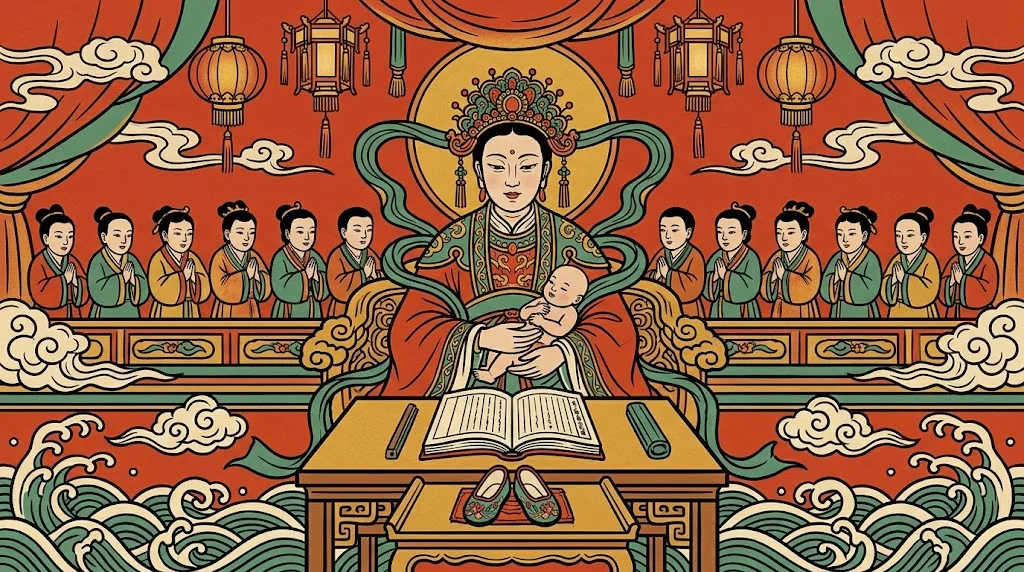
The shoes are what you notice first. Tiny ones, most of them — the kind that babies wear before they can walk, soft-soled and embroidered with flowers or tigers or small smiling suns. They line the base of the altar in rows, some pairs still bright and obviously new, others faded to the washed-out pastels of objects that have been handled and kept for years before being brought here. Between them, threaded through the offering railings, are lengths of red ribbon. There are red eggs in a ceramic bowl. There are paper cutouts in the shapes of children. And at the center of all this, the goddess — Zhusheng Niangniang, the Lady Who Bestows Birth — sits with her hands resting open in her lap, her expression the particular softness of a face that has been looking at infants for a very long time. A couple stands before her altar. They have been standing in this same spot, this same temple, twice a month for the past year and a half. The woman holds a pair of tiny shoes — red, embroidered with goldfish, bought at the market last week in an act that felt like tempting fate and also like insisting on hope at the same time. She places them carefully at the altar's edge. Her husband stands beside her and his jaw is doing the thing it does when he is not allowing himself to say whatever he is thinking. Zhusheng Niangniang exists at the intersection of every tradition's deepest question: what does it mean that children come and sometimes do not come, that some pregnancies hold and others don't, that the thing most wanted is also the thing least within anyone's control? She does not promise outcomes. She is a keeper of the register, and the register includes everything — the arrivals and the absences both. Along the sides of her altar stand twelve smaller figures — the Twelve Lady Officials, each one cradling an infant, each one presiding over one year in the twelve-year zodiac cycle. They are the divine midwives of the cosmic calendar, the administrators who process each new life from the celestial registration office to the physical world. Every child who is born has passed through their hands. Women come to her at every stage of the reproductive arc. Young women who are not yet ready come to make themselves known to her. Women who are trying come with specific, urgent prayers. Women who are pregnant come to ask for protection through the process. After a successful birth, mothers come back to thank her and to introduce the child — to complete the circuit, to say: this is the one. This is the one I was here asking about. Some parents bring the child's first shoes to leave at the altar, which is why the altar always has them, layer upon layer of firsts accumulated over years. And women come who have experienced loss. Miscarriages. Stillbirths. Infants who arrived and then didn't stay. The altar receives those offerings too — the shoes bought in hope for a child who didn't come home, the eggs that represent beginnings, the paper children that stand in for ones who existed briefly in the ledger and then were removed. The goddess receives all of it. New Year's, in the lunar calendar, is the busiest season at Zhusheng Niangniang shrines across Taiwan. The incense burns in such quantities that the smoke rises from the temple roof in a visible column — a signal, though not an intentional one, of how many people are standing in the same courtyard with the same fragile cargo of hope. The couple at the altar bow three times. The woman's hand touches the base of the altar for a moment as she straightens — a brief, unplanned gesture. The shoes are in place. Whatever happens next is in the ledger, or will be, at the moment it becomes real. The goddess keeps track. She always has.
← Back to Deity Stories