Seventy-Three Lives
Main Deities: Wenchang Dijun
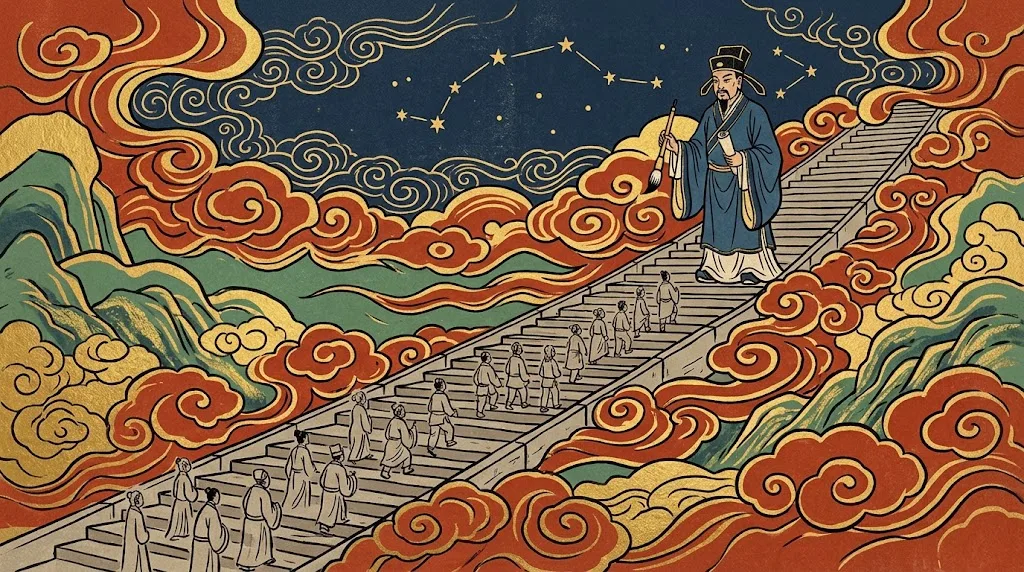
Two days before university entrance exams, a girl lays a sharp new pencil on the offering table. She has brought it in its original packaging, unsharpened, because she read somewhere that the pencil should be new. Beside it she places a photocopy of her exam registration card. She is not sure these are the right things to bring and she is not sure exactly what she's asking for, but she lights the incense and stands before the altar of Wenchang Dijun — the God of Literature, the celestial official of examinations, culture, and the written word — and she says, in the shorthand of someone who has been studying for eight months: please let me remember what I know. Wenchang Dijun is the deity of the educated and the aspiring. He presides over the specific anxiety of the examination hall, which in Taiwan, as in the China from which Taiwan's religious traditions descended, is the anxiety of life itself. For most of Chinese imperial history, the examination system was the only legitimate path from poverty to power. A farmer's son who scored high enough could become a government official. Everyone who sat those exams was praying to the same god. The legend of Wenchang Dijun is unusual because it is explicitly a story about accumulation. Most gods are made in a single moment — a sacrifice, a martyrdom, a miraculous act. Wenchang Dijun was made through repetition. According to the tradition, his mortal form — a man named Zhang Ya — had to live seventy-three separate lifetimes before he had accumulated enough moral merit, enough wisdom, enough demonstrated integrity across enough different circumstances, to be worthy of the celestial appointment. Seventy-three lives. The number has a weight to it. It is not a round number, which makes it feel more serious. Someone counted. Someone maintained a record across seven dozen incarnations, tracking the decisions made and unmade, the moments when Zhang Ya could have taken the easier path and didn't, the moments when he failed and came back and tried again. He served in government and made decisions that were just, even when they were politically costly. He was kind in the texture of daily life in the way that kindness is harder to sustain than dramatic sacrifice — steadily, without recognition, in the ordinary choices of ordinary days. At the end of the seventy-third life, the celestial appointment came. He was placed in charge of the Northern Dipper stars and given authority over the fate of those who pursued learning and literary achievement. His temples in Taiwan tend to be quieter than the great pilgrimage temples of Mazu or the busy commercial halls of Guan Gong. They have a particular atmosphere — calm, concentrated, faintly pressured, like a library the night before something important. The offerings people bring are not food and incense primarily but objects of study: pencils, rulers, books, exam registration forms, notebooks. Some people bring their textbooks and hold them up to the altar. Parents bring their children's report cards. Graduate students bring their thesis proposals. The ritual logic is layered. At one level it is simply petition — please help me pass. But at another level, the offering of study materials is a statement of seriousness. It is saying: I am genuinely trying. I have done the work. I am not asking for a miracle in place of effort; I am asking for the effort to count. This is, appropriately, exactly the kind of prayer that a god made through seventy-three lives of incremental moral effort would find meaningful. The girl at the altar retrieves her incense sticks when they've burned down far enough. She bows. She picks up her pencil — still in its packaging — and puts it in her bag. In two days she will use it to fill in small circles on a form that will, in some significant way, determine the shape of the next decade of her life. The god of those circles watches from the altar, old beyond counting, patient beyond understanding, made from the long accumulation of trying.
← Back to Deity Stories