The God Next Door
Main Deities: Tu Di Gong
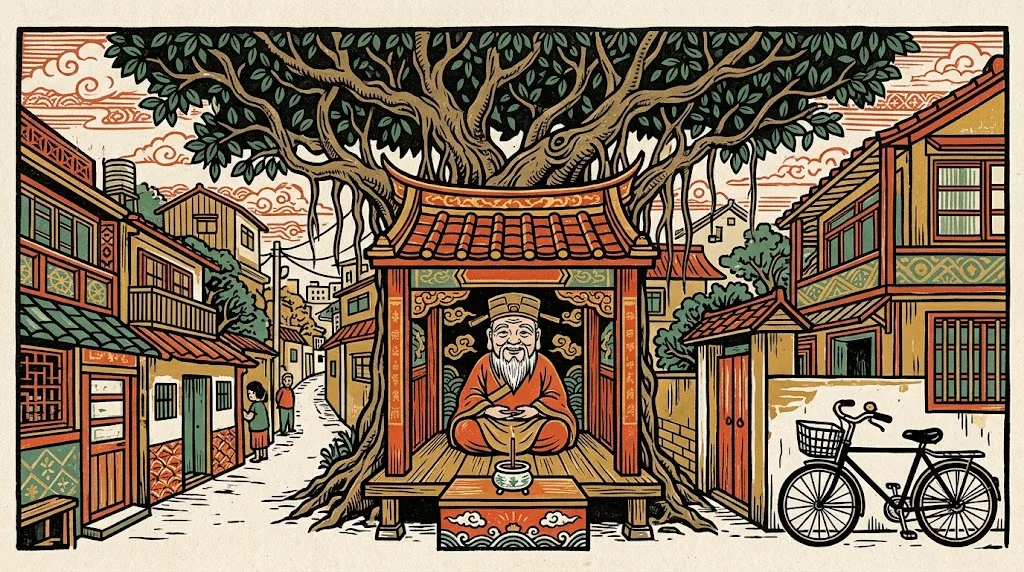
You've walked past him hundreds of times without knowing his name. He's the small red shrine at the base of the old banyan tree on the corner. He's the figurine with the white beard and the golden staff sitting inside a miniature temple no bigger than a mailbox, his expression mild and grandfatherly, smoke curling up from incense sticks like a tiny perpetual fire. In Taiwan, Tu Di Gong — the Earth God, the God of the Soil — is everywhere. He is the most numerous deity on the island, the most intimate, the most democratic. While Mazu commands the seas and Guan Gong oversees the great questions of loyalty and honor, Tu Di Gong watches over the patch of ground directly beneath your feet. His story begins with a man named Zhang Fu-de, who served as a minor tax official during the Zhou Dynasty — which is to say he spent his working life doing a job that no one has ever loved. He collected grain payments from farmers and delivered them to the state. He kept records. He moved through the countryside between one village and the next, a bureaucrat in an era of bureaucrats, unremarkable in almost every way — except one. He was kind. In a system designed to extract, Zhang Fu-de gave back where he could. He reduced assessments for families in genuine hardship. When the harvest failed and farmers couldn't pay, he sometimes covered the difference himself. He lived simply and died poor, which was not supposed to be the reward for such a career but turned out to be the only appropriate ending for a man like him. The most famous story about him comes from after his death. A young woman from a poor family had died, and her family could not afford proper burial clothes to wrap her body for the grave. They had nothing. Zhang Fu-de appeared and gave the family his own overcoat to wrap around the girl. A dead man giving his coat to a dead girl. The gesture was so purely human, so uncalculated, that her spirit petitioned heaven on his behalf. He was made Earth God — which sounds like a grand promotion until you understand what it actually means. He was not given a celestial throne or a role in the dramas of the heavenly court. He was given the ground. He was placed back in the villages and the markets and the back alleys, stationed at the intersections and the thresholds, appointed guardian of exactly the kind of ordinary, unheroic places where a tax official spends his life. It was the perfect match. Modern Taiwan has not retired him. If anything, the density of urbanization has only multiplied his shrines. Every building has one. Every market has one. Every roadside noodle stand has a small Earth God altar tucked under the counter or behind the cash register. He appears in the lobbies of banks and in the parking garages of luxury apartment buildings. His image has stayed consistent across centuries: white-haired, white-bearded, rosy-cheeked, his expression permanently set to the particular benevolence of someone who has heard every kind of problem and is not surprised by any of them. The offering rhythm for Tu Di Gong is built into people who grew up in Taiwan the way breathing is built in. Twice a month, without thinking very hard about it, you stop at the small shrine and light the sticks and say what needs to be said. You don't ask for miracles. You ask for things like: let the rent not go up. Let the customers come. Let the traffic be light and the thing I'm worried about turn out to be nothing. He is not the god you pray to when you're desperate. He's the god you check in with when you're just trying to get through another month. That is exactly the kind of god that Zhang Fu-de, the careful tax collector who gave away his coat, would understand.
← Back to Deity Stories