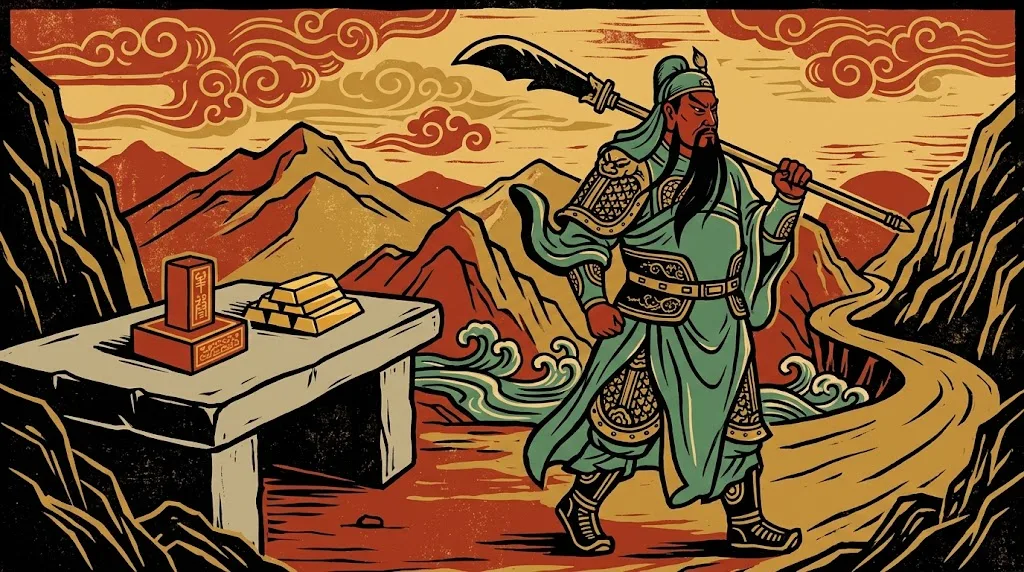
The General Who Chose Honor
Main Deities: Guan Gong
On a Tuesday morning in Taipei's Zhongshan District, a man in a pressed suit stands before an altar with his eyes closed and his hands pressed together. The incense he's holding is burning down toward his fingers but he doesn't seem to notice. Behind him, the sounds of the city flow through the temple's open doors without touching him. On the altar in front of him stands a figure nearly two meters tall, red-faced, black-bearded, dressed in the armor of a Han Dynasty general, one hand resting on a massive crescent-bladed halberd. The man's lips are moving. He's asking for something, or maybe he's promising something. At Xingtian Temple, one of Taipei's most visited shrines, it's often hard to tell the difference. Guan Yu — known in Taiwan as Guan Gong, or Ensheng Dijun, the Sacred Emperor Who Subdues Evil — died in 219 AD, beheaded after being trapped in an ambush at the Battle of Maicheng. He was one of the greatest military generals of his era, sworn blood-brother to Liu Bei, the warlord who spent his life trying to restore a crumbling dynasty. The story of how Guan Yu became a god begins not with his death but with a choice he made years before it — a choice so clean and absolute that people are still talking about it two thousand years later. After a disastrous military campaign, Guan Yu was captured by the rival warlord Cao Cao, one of the most powerful men in China. Cao Cao treated his prisoner not like a captive but like a guest of honor. He gave him a mansion. Fine horses. Silk robes. Lavish banquets. He promoted him to the rank of general within his own armies. He gave him every possible reason to stay. Guan Yu stayed long enough to repay a debt — he fought under Cao Cao's banner in one battle to clear his own honor and obligation. Then he gathered the female relatives of Liu Bei who had been in his protection, loaded them onto carts, and walked away from everything Cao Cao had given him. The mansions, the horses, the promotions, the silk — he left it all. When Cao Cao's generals moved to stop him at the various checkpoints, Guan Yu cut through them, not out of hatred but out of pure determination to get back to the man he had sworn an oath to. The point is the refusal. The point is that when offered everything he could have wanted, Guan Yu chose the harder road because he had given his word. He was killed sixteen years later, betrayed and outmaneuvered. His ghost — according to the old stories — did not scatter or disappear. It appeared at various temples, still armored, still loyal. Monks began to worship him. By the Song Dynasty, emperors were granting him posthumous titles. By the Ming Dynasty, he had been elevated to the rank of Emperor of Heaven. Today in Taiwan he sits at the intersection of several worlds that should not overlap. Businessmen pray to him for honest deals and fair partners. Police officers have him on their desks because he represents the moral authority of the law. And for decades, organized crime groups in Taiwan also venerated him — because in that world too, the worst thing a person can do is break an oath. Guan Yu doesn't care which table you're sitting at. He cares only whether you keep your promise. The man in the suit at Xingtian Temple opens his eyes. He bows three times, tucks the burnt-down sticks into the offering vessel. Whatever he came to ask — or to promise — is now between him and a general who has been dead for eighteen centuries and still somehow commands a room.
← Back to Deity Stories