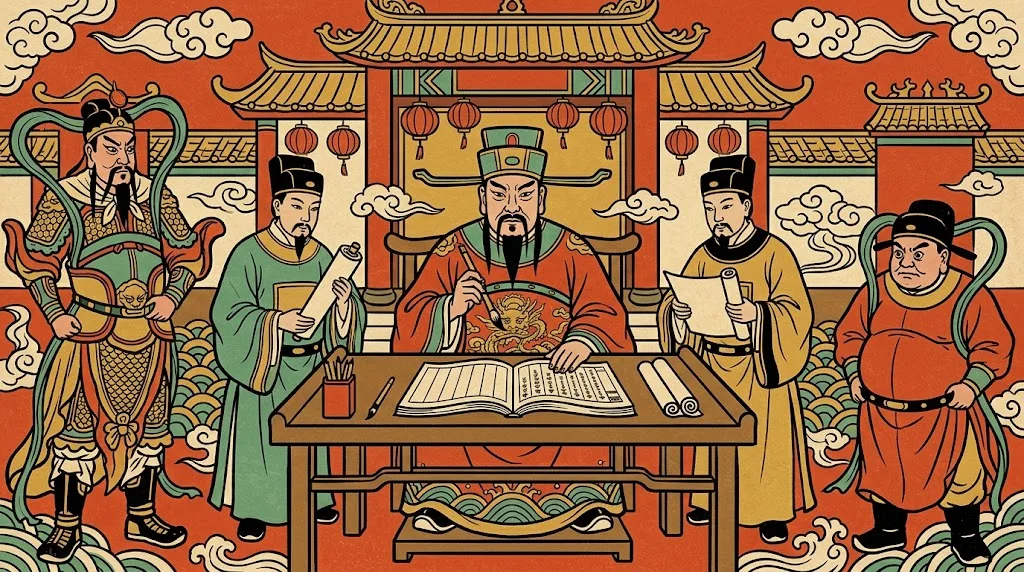
The Judge at the Gate
Main Deities: Chenghuang
Imagine you are an official in imperial China. You have spent your career administering a city: settling disputes between merchants, managing the grain stores, overseeing public works, judging crimes, processing the ten thousand small frictions that arise whenever human beings live in close proximity to one another. You are not a famous man. You are a magistrate. You do the work. You try to be fair, because the pressures from above are considerable and the bribes from below are constant temptation. You try anyway. You die in office, and your ghost does not dissipate. This is how Chenghuang is made. Not through legend, exactly, but through a kind of divine civil service appointment. The position of City God — Chenghuang, the God of Walls and Moats — is filled by the promoted spirit of a virtuous official who knew the city while he was alive and has agreed to continue administering it after death. Each city has its own. The Chenghuang of Hsinchu is not the Chenghuang of Tainan. They have different faces and different histories, and the people of each city feel a specific, almost proprietary attachment to their own local god. What does a City God actually do? In the religious cosmology of Taiwan, he is the first point of contact between the living world and whatever comes after. He keeps a register — the name of every person living within his jurisdiction: when they were born, what they have done, what they owe, what is owed to them. When someone dies, their soul appears before him. He reviews the ledger. He renders a judgment — not as a punisher, exactly, but as a bureaucrat of the afterlife, the official who processes the paperwork and routes each soul to wherever it needs to go next. There is an old story about a man who knew he was dying. He had left things unfinished. A debt unpaid. A wrong done to a business partner twenty years before. A promise to his mother that had slipped away into the busyness of his life. He was not a bad man — he was an ordinary man, which is to say he was a mixture, like everyone. But he lay on his deathbed and understood that he was about to go stand before the City God, and that the ledger would be accurate. This is the texture of the Chenghuang story: not terror, exactly, but the specific unease of knowing that someone has been keeping track. The City God is not a devil. He doesn't want to punish you. He wants the books to balance. He is the divine equivalent of the official who stamp-approves your documents — patient, thorough, impossible to fool. In Hsinchu, the Chenghuang Temple was built in 1748, one of the oldest continuously operating temples in northern Taiwan. The City God's birthday celebration is one of the most spectacular in the Taiwanese religious calendar — a massive parade through the old city streets, lanterns, drum corps, and the God's palanquin making a circuit of his domain. It is simultaneously a birthday party and a civic inspection tour. He is, in theory, checking on his city. Noting who turned out to greet him and who stayed home. Modern Hsinchu residents who grew up with this temple describe the same childhood memory: lying awake on the night of the parade, listening to the distant drums growing louder, and feeling something that wasn't quite fear but was adjacent to it. The awareness that the city had a watcher. That the accounts were being maintained. It is a feeling that, once installed in childhood, never entirely leaves.
← Back to Deity Stories