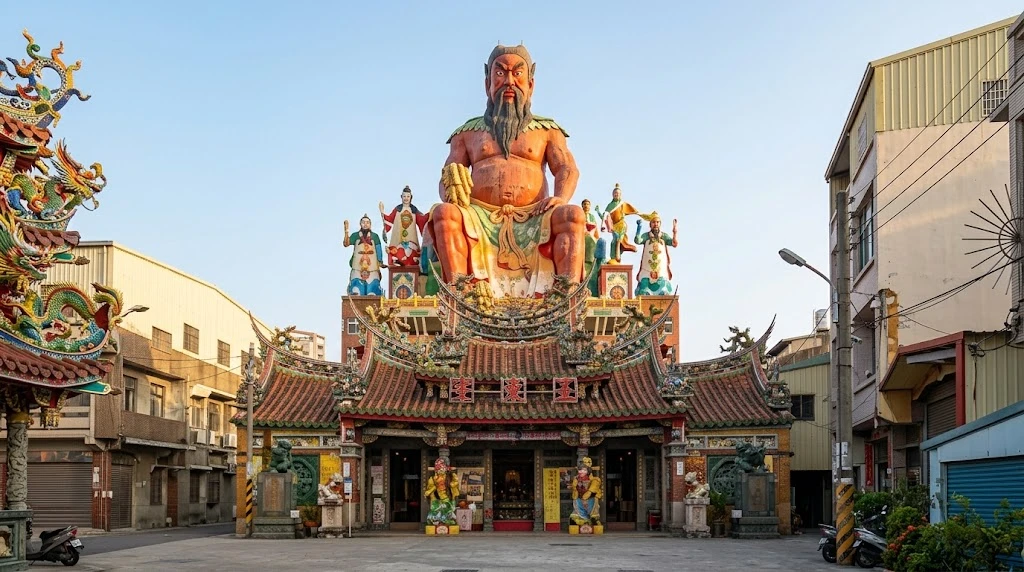
Zhunan Wugu Temple
Main Deities
About
Ride the train through Zhunan, glance out the window, and a 46.8-meter statue of Shennong, the Divine Farmer, suddenly appears. That is Wugu Temple. Completed in 1998, the giant statue has become the most recognizable landmark in all of Zhunan: you do not need to check the timetable, because when you see him, you know you have arrived. Its full name is the Zhunan-Toufen-Zaoqiao Wugu Temple, and it is dedicated to Shennong, the Emperor of the Five Grains, worshipped jointly by the Hoklo and Hakka communities of Zhunan, Toufen, and Zaoqiao. In an era of sharp ethnic boundaries, this kind of shared Hoklo-Hakka worship was quite rare. Shennong watches over farming and medicine, and for more than two hundred years, people here have always come to tell him first how the harvest is going.
History
In 1739, the fourth year of the Qianlong reign, Lin Ershun of Quanzhou led more than thirty settlers of Fujianese and Cantonese origin to sign an agreement with the local indigenous people to open land along the Zhonggang River, and that year they began worshipping Shennong: first came the land clearing, then the faith. In 1797, the second year of the Jiaqing reign, landholders including Zhang Zhengyang, Zhang San, and Wang Xian proposed building a temple, and Wugu Temple finally had a permanent hall. In 1851, the first year of the Xianfeng reign, an incense division went to the Sanwan Wugu Temple, and in 1874, the 13th year of the Tongzhi reign, the temple was rebuilt and a donors' stele was erected, recording the names of those who gave money and labor. In 1998 the giant Shennong statue was completed, turning a farming faith of more than two centuries into the most eye-catching landmark beside the railway.
IllustrationZhunan Wugu Temple
Zhunan Township, Miaoli County
Visitor Info
Address
No. 16, Wugu St, Zhunan Township, Miaoli County
Region
Zhunan Township, Miaoli County
Plan Your Visit
- Hours
- Daily 5:00 AM – 9:00 PM
- When to Go
- Shennong Dadi's birthday on lunar 4/26 is the most important celebration of the year.
Checked on 2026-10-13 · Sources: Google Maps