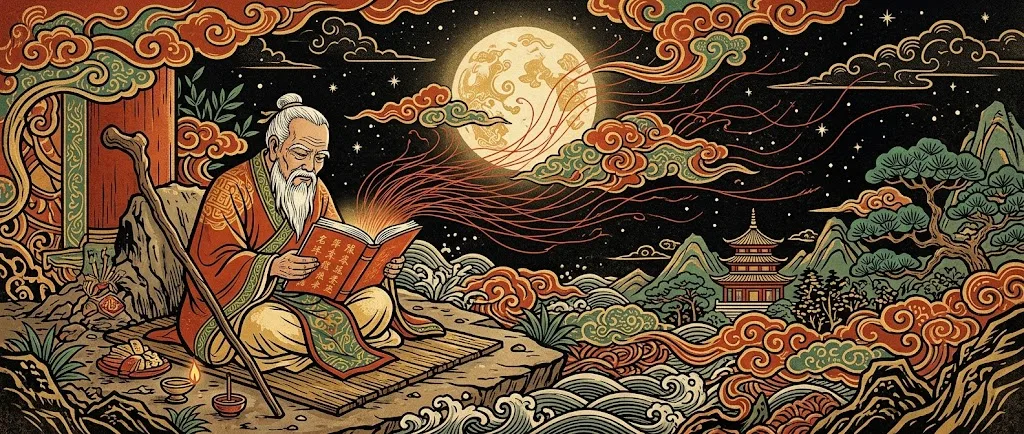
The Red Thread That Cannot Be Cut
Main Deities: Yue Lao
On a weekend morning at the Xiahai City God Temple in Taipei's Dadaocheng neighborhood, the queue for the Yue Lao altar stretches out through the main hall and into the temple courtyard. The people waiting are mostly young — twenties, early thirties, some of them in pairs who have come to have their relationship blessed, others alone and carrying the particular stillness of someone who has been alone long enough to come stand in a queue about it. When they reach the altar they receive red threads and wooden divination blocks, and then they pray to a small figure with a white beard who sits amid an absolute profusion of red string, red ribbons, red fabric of every kind, as though the altar itself has been tied together by the same thread that ties the lovers. Yue Lao is the Old Man Under the Moon, the keeper of the register of marriages, the deity who ties the red thread of fate. His story comes from a tale written in the Tang Dynasty — the invisible infrastructure of human love. A young man named Wei Gu was traveling and stopped for the night at an inn. In the predawn darkness he came across an old man sitting in the moonlight, reading from an enormous book. The book was thick and the old man seemed completely untroubled by the cold. Wei Gu asked what he was reading. The book, the old man explained, was the register of marriages. Every union that would ever occur was written in it. Beside him was a bag filled with coils of red thread — the actual threads that connected each destined pair, tied invisibly around their ankles at birth. The threads could cross any distance. They could pass through walls and across oceans and through the decades of a life. They could not be cut. Wei Gu asked the old man who he was destined for. The old man showed him an entry: his future wife was a three-year-old girl at a vegetable stall in the market, the daughter of an old woman who sold greens there every morning. This is the part of the story that is designed to be uncomfortable. Wei Gu felt a specific kind of outrage — at fate, at the randomness of it, at the idea that the person he would spend his life with was currently a toddler who could barely walk. He went to the market. He found the stall, and the old woman, and the small girl. And then he sent a servant to kill the girl. The servant was not, apparently, very good at this task. He stabbed the girl in the forehead and fled. She survived with a scar above her left eyebrow. Wei Gu left the city and did not think about the old man under the moon or the girl with the scar again for a very long time. Fourteen years passed. Wei Gu eventually married a woman of good family — beautiful, intelligent, the kind of match that felt uncomplicated. On their wedding night, he noticed she wore an ornament over her left eyebrow. He asked about it, gently. She told him she had been injured as a child. A servant had stabbed her when she was very small. She had grown up with the scar and learned to cover it. Wei Gu did not sleep that night. The story simply notes that Wei Gu was a good husband, and that he understood — as few people understand — exactly what the red thread felt like from the inside. He had tried to cut it with a knife, and instead had only written the scar into the story. At the Xiahai Temple, the Yue Lao altar is covered with red threads that previous visitors have tied after their prayers, layering over years into something that looks almost geological, like sediment from ten thousand hopes left in one place. Young people tie threads and wish for someone specific, or for someone to appear, or simply for the thing that Wei Gu had tried so hard to escape and found himself arriving at anyway. The old man under the moon keeps reading. The bag beside him is never empty. And somewhere, on two people who haven't met yet, the thread is already tied.
← Back to Deity Stories