Born of Lotus Fire
Main Deities: Nezha
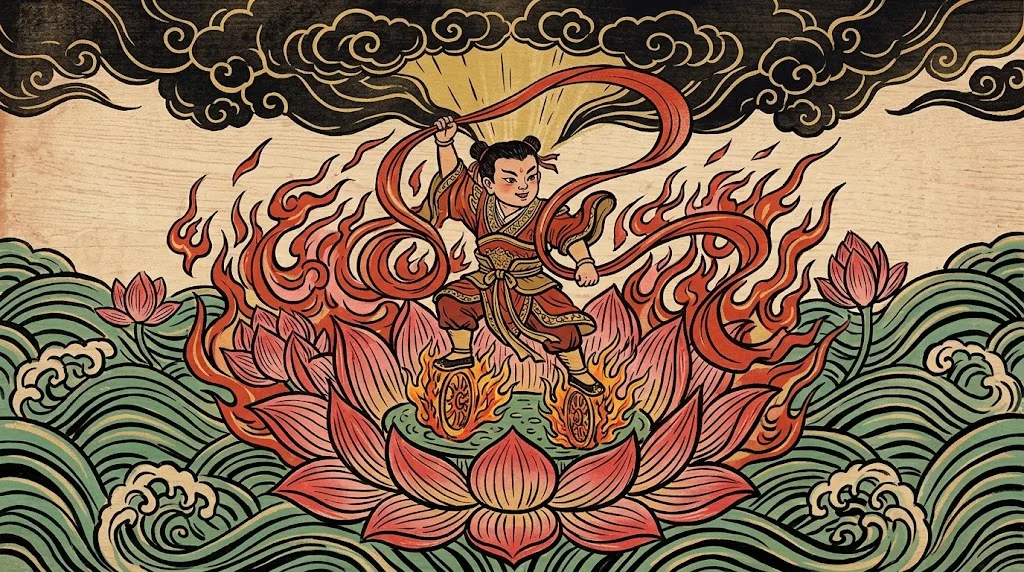
There is a temple parade in a small town on the western coast of Taiwan, and at the center of it a group of teenagers is carrying a palanquin on their shoulders. The statue inside is small and brightly painted: a boy of perhaps seven or eight, round-cheeked, standing on two spinning wheels of fire, a red sash streaming behind him, one hand raised holding a gold ring, his expression a very specific kind of cheerful and dangerous. This is Nezha, the Third Prince, the Lotus Prince, the one who was born and died and came back and has not slowed down since. His mother was pregnant for three years and six months. This is the detail the old texts always emphasize — the unseasonable length, the weight of it, the way time itself seemed to stretch around whatever was forming inside her. When she finally went into labor, she did not deliver a child in the ordinary sense. She delivered a sphere of red light that flew apart to reveal a boy with a gold bracelet on his wrist and a red sash already wrapped around his body, as if he had dressed himself for the occasion before arriving. He was, from the first moment, too much. He killed the Dragon King's third son in a dispute at the sea — the son had come to demand tribute from local villages and Nezha had objected, in the direct and physical manner he preferred for most objections. The Dragon King went to Nezha's father, Li Jing, a military commander of the heavenly hosts, and demanded justice. Li Jing was caught: his son had committed an act that could start a celestial war, and Nezha showed no remorse. Nezha had not asked to be born. He had not asked for parents who would weigh him against military protocol and find him expendable. He had not asked for a father who could look at his child and see first a complication. And so he did the only thing he could ever have done. He took a knife. He returned his flesh to his mother. He returned his bones to his father. He gave back everything they had given him, piece by piece, until there was nothing left that could be claimed by anyone. And then he died. His teacher, Taiyi Zhenren, a celestial sage who had recognized what Nezha was from the beginning, gathered lotus flowers from a sacred pond. He built a new body from them — each petal a piece of something that belonged to no one, that had never been owned. Nezha rose from the lotus flowers, reconstructed and remade, and the first thing he did was go find his father. The confrontation between them is one of the most emotionally complex moments in the old mythology. Nezha wanted to kill Li Jing. Li Jing felt the particular guilt of someone who had chosen correctly by every official measure and still done something irreversible. They were stopped by divine intervention before the encounter became fatal. But that moment of the lotus rebirth is the moment that Taiwan keeps returning to. Nezha shrines are colorful and loud and busy, decorated with his fire wheels and his gold ring and his red sash. The spirit mediums who channel him often behave with an energy that is barely controlled, vibrating with something that seems too big for the body channeling it. Because Nezha is the god of the child who was too much. Who couldn't fit into the shape that was expected. Who was given a terrible choice and chose total refusal. The teenagers carrying his palanquin through the coastal town do not think about this theology. They are sweating and the drums are very loud and the firecrackers smell like sulfur and celebration. But there is a reason that Nezha resonates in twenty-first century Taiwan the way he does. He is the boy who said: I did not come from you. I made myself. And he came back from nothing on fire.
← Back to Deity Stories