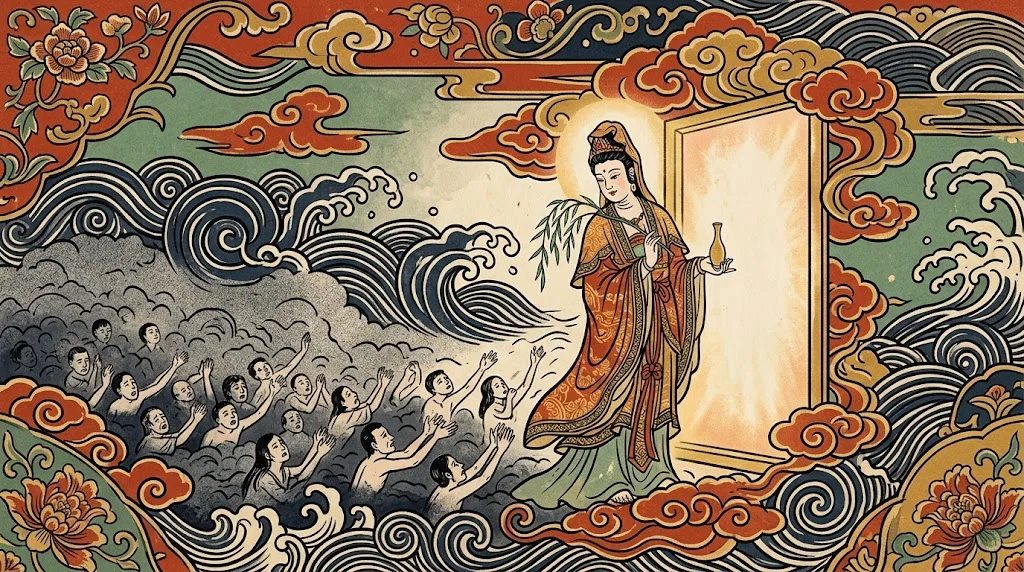
The Vow That Changed Everything
Main Deities: Guanyin
The mother has been awake for three days. Her son is in a hospital room two floors above and the doctors have been using words she doesn't understand, and at some point in the small hours of the third night she found herself standing inside a temple she doesn't usually visit, holding incense she bought from the vendor at the entrance without quite knowing why. She is not particularly religious. But she is standing here now in front of a figure in white — serene, seated, one hand open as if offering something — and she is saying, out loud, into the incense smoke: please. Just please. Guanyin is the deity people reach for at that moment. Not because she guarantees outcomes but because her entire existence is, in one sense, the act of reaching back. Her story comes in two forms that have wound together over centuries. The first is a cosmic story about a bodhisattva — a being who had accumulated enough spiritual merit to leave the cycle of suffering and enter nirvana, the permanent state of peace that is the goal of all Buddhist practice. This being stood at the threshold and looked back at the world: the children dying of fevers, the old men lost on mountain roads, the soldiers drowning in rivers. And she made a vow. She would not enter nirvana until every single sentient being had been freed from suffering. The scale of that vow is staggering if you sit with it for a moment. She was choosing an infinite sentence of compassion. She was saying: I will be here as long as suffering exists. Her name — Guanshiyin in its full form, shortened to Guanyin — means the One Who Perceives the Sounds of the World. The cries. The sounds that people make when they are at the end of what they can hold. The second story is more human and more brutal. Princess Miao Shan was the third daughter of a king who wanted her to marry a wealthy man. She refused — not out of stubbornness but out of a conviction that there was a different way to be in the world. She wanted to become a Buddhist nun. Her father, furious, sent her to a monastery and arranged for the monks to work her so hard she would give up. She didn't give up. Her father had the monastery burned to the ground. Miao Shan walked out of the fire untouched. He ordered her execution, and the executioner's sword shattered. Finally he had her strangled. She descended to the underworld and began to recite scriptures there — and the underworld bloomed. Flowers appeared in the hell realms. The King of Hell, alarmed, sent her back. She returned and lived on an island, healing the sick. Then her father fell gravely ill — and a monk told him the only cure was the eyes and hands of someone who had never once felt anger. The king sent messengers, not knowing who lived there. Miao Shan sent her own eyes. Her own hands. Her father was cured. When he came to thank the healer and discovered what his daughter had done, he converted entirely. And Miao Shan was transformed: a thousand arms grew from her body, each one holding a different tool for helping. A lotus. A vase. A willow branch. A rope. Whatever might be needed. In Taiwan, Guanyin temples are some of the most emotionally charged spaces in the religious landscape. She is the deity of last resort and first impulse. People pray to her for sick children and troubled marriages and personal failures too shameful to tell anyone else. They leave offerings of fresh flowers, because she is associated with purity and the gentle things. The mother in the temple eventually goes back upstairs. Her son recovers. Whether this had anything to do with the incense she burned she will never know, and she knows she will never know. But she goes back to that temple six weeks later with flowers, because something in her feels that she owes the visit.
← Back to Deity Stories