The Doctor Who Healed the Dragon
Main Deities: Baosheng Dadi
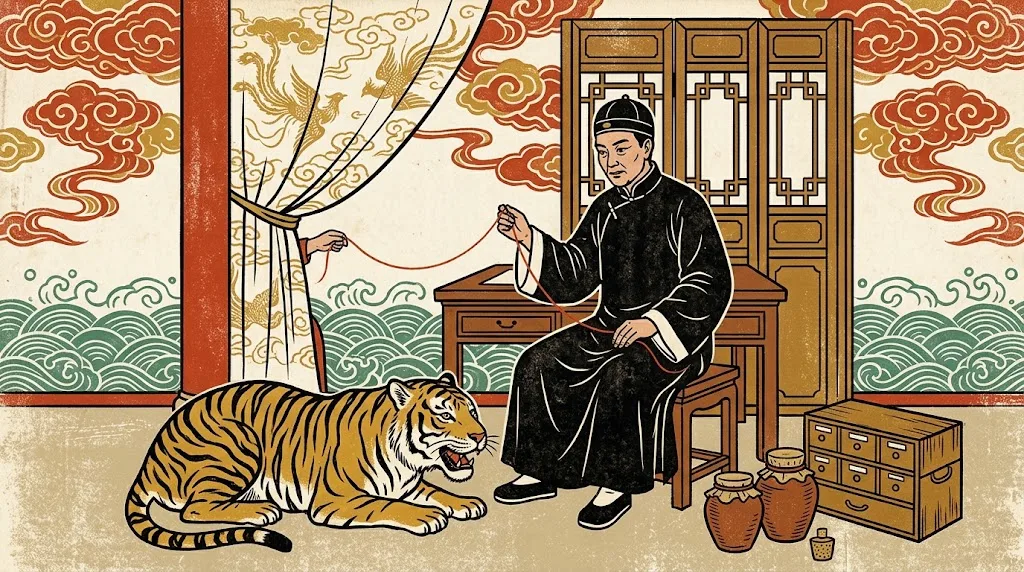
Inside a traditional medicine hall in Tainan, the air is thick with something that takes a moment to identify: dried tangerine peel, licorice root, angelica, the dusty mineral smell of powdered deer antler, all of it undercut by the sandalwood of incense burning at the small altar in the corner. On the altar sits a figure in robes of white and red, his expression one of absolute calm, one hand raised in a gesture that could be greeting or benediction. Baosheng Dadi — the Great Emperor Who Protects Life — watches over pharmacies and clinics and hospitals across Taiwan. His mortal name was Wu Tao. He was born in 979 AD in Fujian province, into a family with some tradition of herbal medicine. He became one of the most gifted physicians of his era — the body as a system in constant negotiation with its environment, health as balance rather than the absence of disease. Wu Tao learned acupuncture and herbalism and diagnosis by pulse, which in the Chinese medical tradition is a complex art involving listening to dozens of distinct qualities of the blood's movement through the body. He charged the wealthy and refused payment from the poor. This was not a policy or a philosophy — it was simply how he practiced, because he had decided early that medicine was a response to suffering, and suffering did not require means-testing. The story that has most attached itself to him involves a thread and a door and the particular absurdity of imperial protocol. He was summoned to treat the Empress, who was gravely ill. But no male physician could directly examine or touch the Empress. Court etiquette was absolute on this point. A silk thread was passed through a small gap in the curtain and tied around the Empress's wrist on the other side. Wu Tao took the other end between his fingers. Diagnosis by pulse through a silk thread is, by any rational measure, impossible. But the old stories are unanimous: Wu Tao held the thread for a long moment in silence, and then he listed the Empress's symptoms, the nature of her illness, and the prescription that would cure her. He was correct on every point. The court physicians who had failed to cure her were standing in the room. No one said anything for a moment. The second story is stranger and more beloved. A tiger came to Wu Tao, unable to eat, pacing and miserable. Wu Tao examined the animal and found a large bone lodged crosswise in its throat. He removed it, which required a steadiness of hand and nerve that most people don't have when standing inside the reach of a very large predator. The tiger did not attack him. According to the legend, it became his companion, wandering near whatever place he was staying, appearing at the edge of the road when he traveled. In the iconography of Baosheng Dadi temples, there is always a tiger somewhere — painted on the walls, carved into the altar furniture, rendered in stone at the temple gates. It is his divine messenger, the grateful animal that chose to serve him. Wu Tao died at fifty-eight. He was on his way to help a family in need when he died. The imperial court, which had offered him titles and rewards that he had consistently declined, posthumously named him. Heaven appointed him to a more meaningful position: the divine administrator of medicine and healing. His birthday, the fifteenth day of the third lunar month, is marked with ceremonies that include medical consultations and health screenings provided free of charge at the temple — a practice that mirrors, with deliberate intention, what Wu Tao himself did his entire life. The incense at the altar in Tainan burns down and is replaced. The doctor who healed the dragon watches from the corner, his expression still that particular calm that belongs to someone who has seen enough suffering to be unshocked by it, and enough recovery to keep believing in it.
← Back to Deity Stories