The Girl Who Held the Sea
Main Deities: Mazu
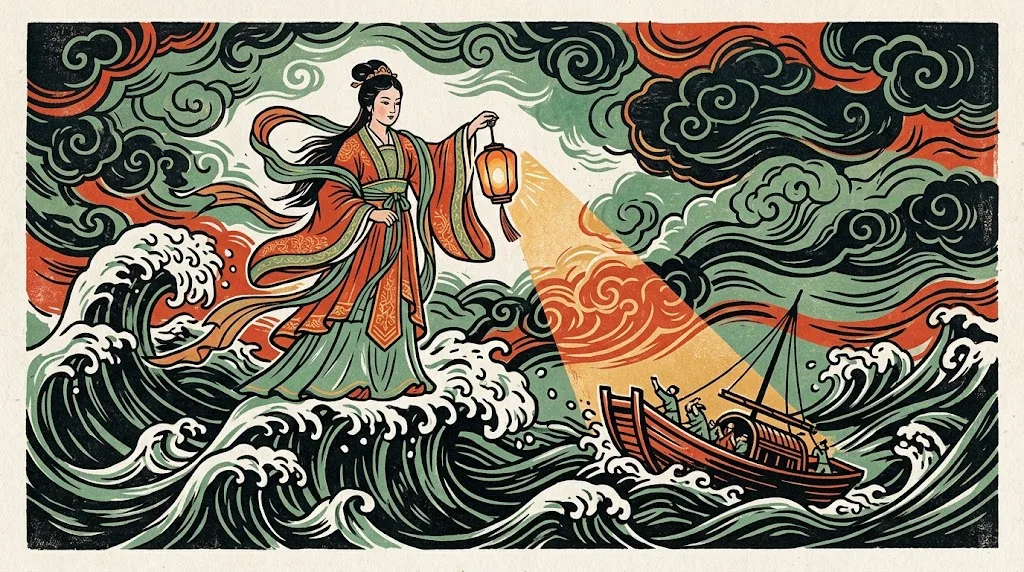
The procession moves before dawn, thousands of paper lanterns bobbing in the dark like a river of light threading through the rice fields of central Taiwan. People press against the road's edge to catch a glimpse of the palanquin — a gilded throne carried on the shoulders of eight men, swaying like a boat in a gentle swell. Inside sits a small lacquered statue, barely two feet tall, her face painted the serene red-black of a woman who has seen the ocean at its worst. Firecrackers split the air. Old women reach out to touch the palanquin as it passes, pressing their hands to the wood as if trying to draw warmth from it. This is the Dajia Mazu Pilgrimage, nine days, 340 kilometers, two million people — and at the center of it all is a girl who died on a cliff above the sea in the year 987 AD, twenty-eight years old, before she ever left her island. Her name was Lin Mo-niang. She was born on Meizhou Island, off the coast of Fujian province in southern China, during a violent storm that the islanders took as an omen. She did not cry when she came into the world, and her parents named her Mo-niang — the Silent Girl. From childhood she was different in ways that her fishing community couldn't quite explain. She seemed to know when the weather was going to turn. She knew which boats would come home and which ones wouldn't. When other children played, she sat at the water's edge and watched the horizon in a way that made adults uncomfortable. She learned to enter deep meditative states — long trances in which her family would find her collapsed but breathing, her eyes moving rapidly beneath closed lids as though she were running somewhere far away. Her father and brothers were fishermen, and they humored her — until the day they understood she wasn't just dreaming. It was during a bad storm on the Taiwan Strait. Mo-niang was at home weaving when she fell suddenly and completely unconscious, dropping to the floor mid-motion. Her mother, panicked, shook her awake. And at that moment, in the water off the coast, one of her brothers' boats lurched violently — the invisible hand that had been guiding it through the waves was gone. The brother's boat survived, but only barely. Her father's boat, separated from the group, was never found. When Mo-niang came to and understood what had happened, she wept — not because of what she had failed to do, but because she had almost done it. She had been there. She had held them. For the rest of her short life she stood on the clifftops in red robes, watching for ships in distress. Sailors began to tell stories of a woman in red appearing on the water during storms, calming the waves, redirecting lost vessels. She died at twenty-eight, at the sea's edge, in a way the old records describe only as ascending — as though the boundary between the water and the sky had simply opened for her. Within decades of her death, temples were being built in her name along the Fujian coast. When Fujian migrants crossed the Taiwan Strait to settle the island, they brought her with them, tucking small statues into the holds of their ships. Today there are over 900 Mazu temples in Taiwan. The pilgrimage that takes place each spring is not a solemn religious march. It is loud and smoky and exhausting and alive. Pilgrims walk through the night, sleep in temple courtyards, eat food distributed by locals who consider it a blessing to feed the walkers. When the palanquin passes through a village, residents drop to their knees and crawl beneath it so that Mazu can pass over them — so that something of her protection can be absorbed through the skin. Old men who can barely walk do this. Mothers hold infants up to be blessed. Teenagers from Taipei who have never fished a day in their lives do it too, because whatever Mazu means has long since expanded beyond fishing and storms. She is the god of passage. Of dangerous crossings. Of the moment when you let go of the shore and trust the water to hold you. Taiwan is an island. It has always understood that.
← Back to Deity Stories